Entanglement asymmetry in the gapped XYZ spin-1/2 chain
A four-part animated presentation of my paper Entanglement asymmetry in the gapped XYZ spin-1/2 chain, written for undergraduates who know linear algebra, probability and introductory quantum mechanics. The presentation is conceptual and analytical: formulas and pictures, no numerical results. Each part is a 20-25 minute live session. The animations were built with Manim and exported with manim-slides; the slides play in the browser, no download needed.
How to drive a deck. Click a part below: the first clip starts on its own. The right arrow (or n) plays the next stop, the left arrow replays the previous one, and space pauses or resumes the current clip. Press f for fullscreen, o for an overview of all stops, s for the speaker notes and ? for every key. The clips are silent: the narration is spoken live, so the notes carry the cue sheet. The handout of each part has one page per stop, the last frame of each clip.
Part 1: Entanglement entropy
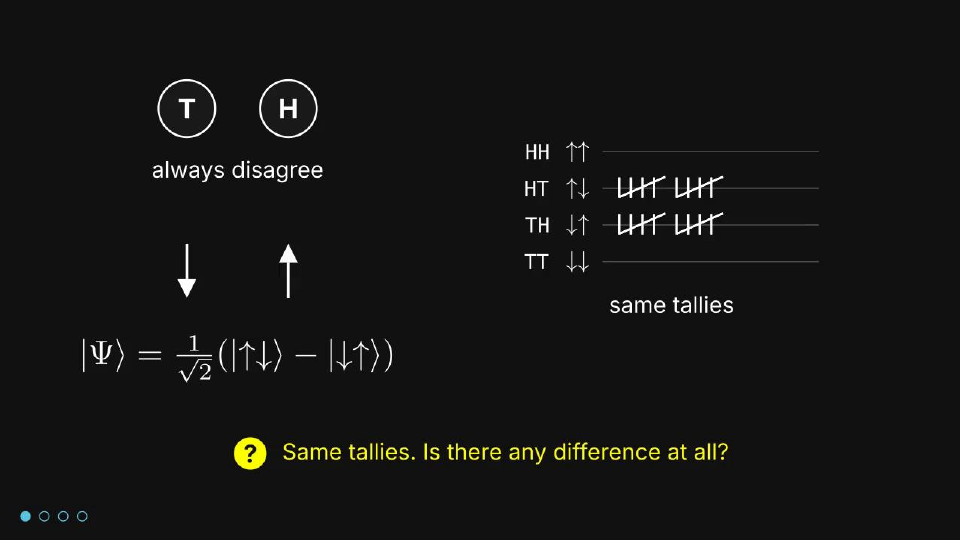
The part that knows less than the whole. Two coins and two spins give the same tallies; the density matrix, its red corners and the partial trace show where the difference hides, and the entropy meter reads it from the eigenvalue bars.
11 scenes, 15 stops, 14 min of animation
▶ Play in the browser Handout (PDF)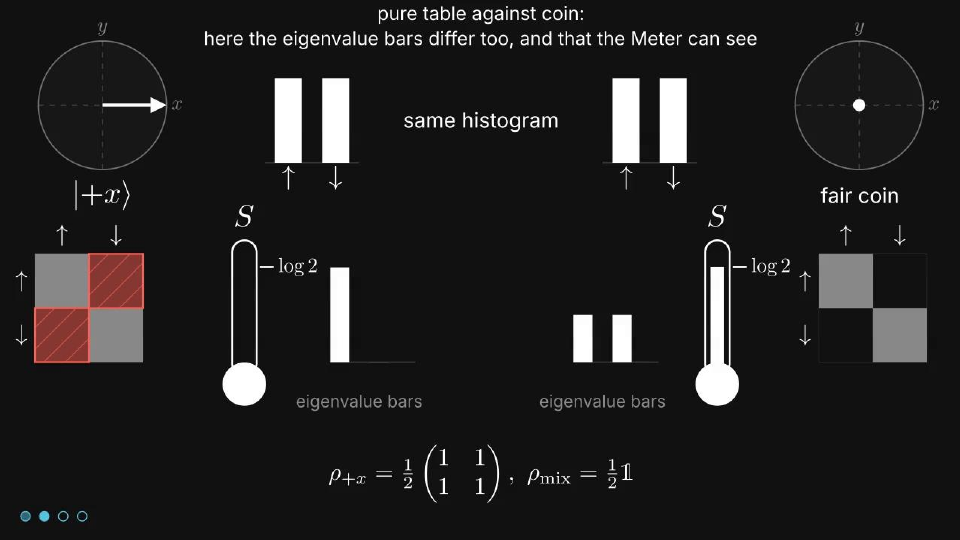
Part 2: Entanglement asymmetry
A meter for a broken symmetry. Sorting the grid by charge, erasing the red blocks between charge drawers, and the Clock average that turns the asymmetry into half the log of the variance of a charge bell.
12 scenes, 24 stops, 17 min of animation
▶ Play in the browser Handout (PDF)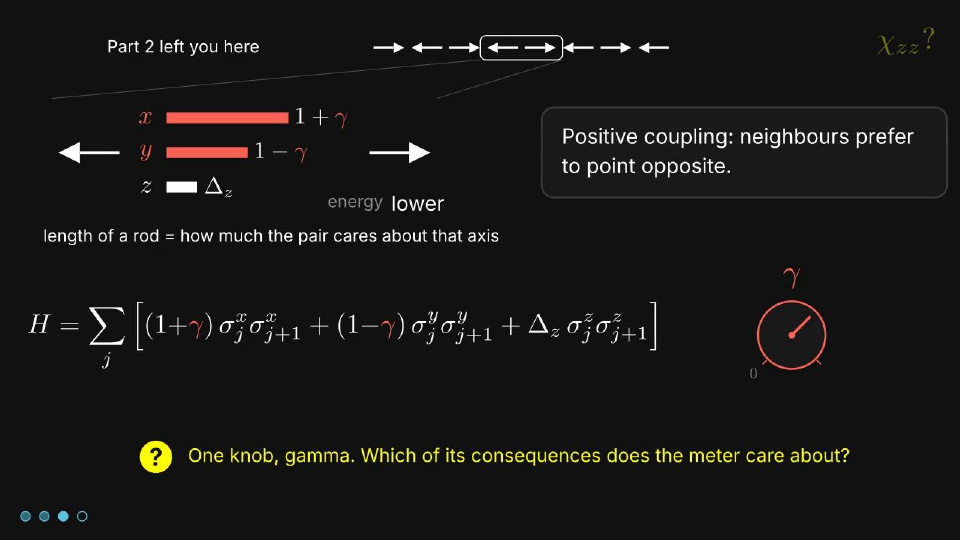
Part 3: The XYZ chain
One knob, a map, stripes, a gap, and misprints that move. The coupling gamma manufactures red corners, the gap buys a short memory, kinks come in pairs, and one measurable quantity, the susceptibility, comes out of the infinite-chain method.
15 scenes, 23 stops, 17 min of animation
▶ Play in the browser Handout (PDF)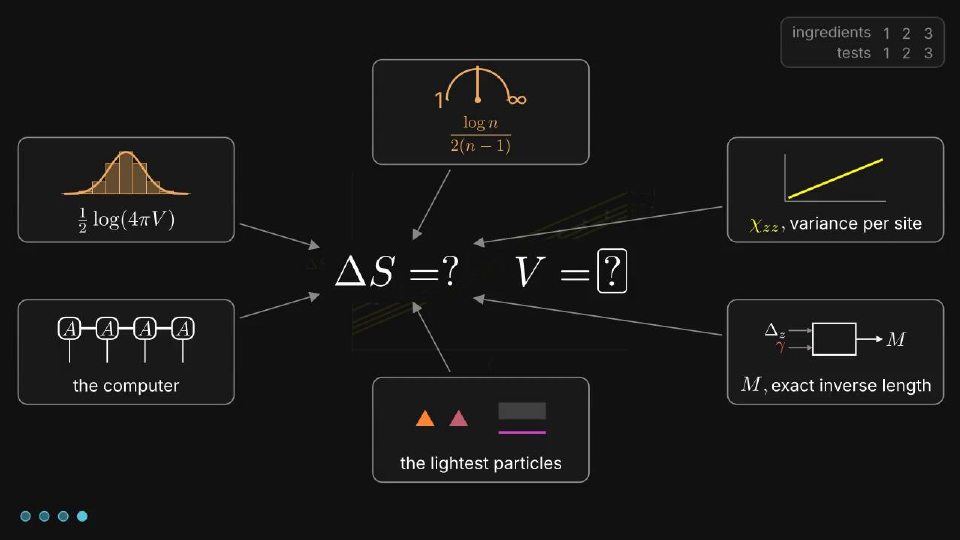
Part 4: Putting the blocks together
The master formula and the paper's figures. The half-log law, two routes to one quantity, the mass machine, the structure of the paper's figures, how an error bar is made, and the closed-form prediction in lattice variables.
15 scenes, 22 stops, 18 min of animation
▶ Play in the browser Handout (PDF)